Read, then listen, then speak

Learn a language by reading what you already read.

LangPepp sprinkles the language you're learning into what you already read. A few words change. The sentence still makes sense. You work out the rest.

Tap a word to hear it. Say it back, and see each sound marked. There is no lesson, and nothing asks you to stop reading.

No account. Offline after the first download. Everything stays on your device.

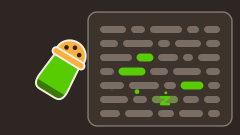
Still of the LangPepp film: a pepper shaker tipped over a page, with a few words turned green.
The shaker tips. The words the grains land on turn into the language you're learning.

A sentence you were going to read anyway

She bought fresh at the market this .

chleb means bread. poranek means morning.

How peppering works

One word at a time, inside your own sentence

Every so often, one word on a page you were reading anyway appears in Polish or Norwegian instead of English. The sentence around it still makes sense, so you work out what the word means. Working it out is what makes it stick.

LangPepp logo: a pepper shaker sprinkling the letters ø and ż onto a page, with two words already green.
  1. 1

    Read

    Common words on the page swap into the language you're learning. The rest of the sentence stays yours.

  2. 2

    Listen

    Tap a word to hear it, spoken by a voice already on your device, at full speed or half speed.

  3. 3

    Speak

    Say the word back. LangPepp marks each sound, on the device, and offers a short tip.

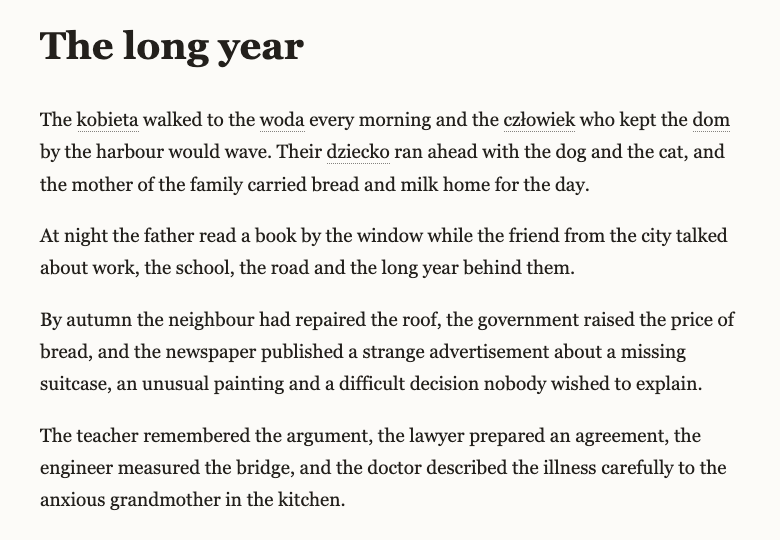
A desktop article titled The long year. In the opening paragraph, Polish words such as kobieta, woda and dziecko keep the page's own type, with a dotted underline.
Subtle style, on a desktop page. Peppered words keep the type of the page, with a quiet dotted underline.
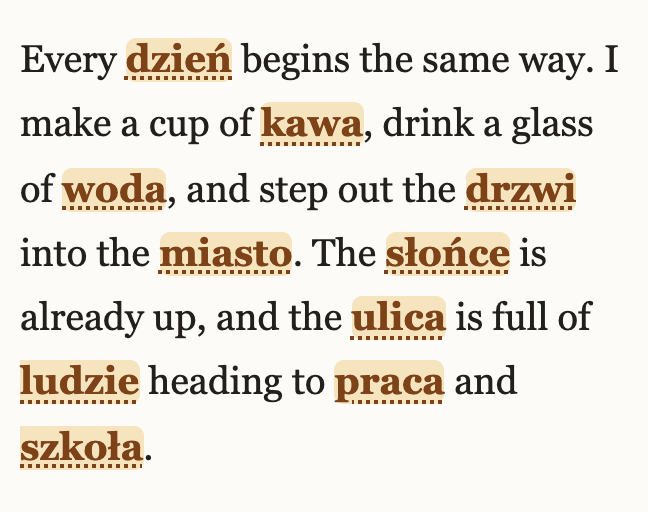
Part of a phone article in highlight style. Polish words such as dzień, kawa, woda and drzwi sit on soft chips inside English sentences.
Highlight style, with the shaker turned up so the words are easy to spot. How many appear is yours to set.

How the words are chosen

Commonest first

Every language pack follows the real frequency order of the language, the way a child meets words. The first words you see are the ones that actually turn up. LangPepp keeps your place in that order, instead of sending you round in circles.

Built from open data

The rankings come from large public word-frequency lists: film and TV subtitles, plus a wide mix of sources from Wikipedia to news. Translations come from open dictionaries such as Wiktionary.

Always in context

The word stays inside your sentence, so the sentence teaches the meaning. You were going to read the page anyway.

The Word Card

Hear it, then read how it sounds

Tap or hover a peppered word. The card shows the word large, its English meaning, and Sona — a plain-English pronunciation you can read on day one.

Sona is not IPA, and that is deliberate. Anyone who reads English can read it. Hyphens split the beats. Capitals mark the loud beat. Arrows (↗ ↘ →) show pitch where the tune matters, as in Norwegian. The card labels Sona “approx.” You can also show IPA beside it, if you already read the phonetic alphabet.

The little chili on the card is Peppy, a companion who reacts while you listen and speak. Peppy is not the logo. The logo is the shaker.

Polish · woman

ko-BYEH-tah

  1. ko a quiet beat
  2. BYEH the loud beat
  3. tah a quiet beat

Norwegian · woman · approx.

kveenuh ↗↘

  1. kveenuh said as it looks
  2. ↗↘ the pitch, shown not scored
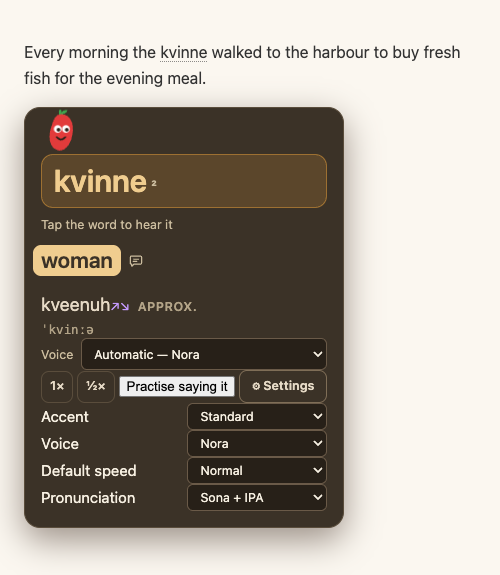
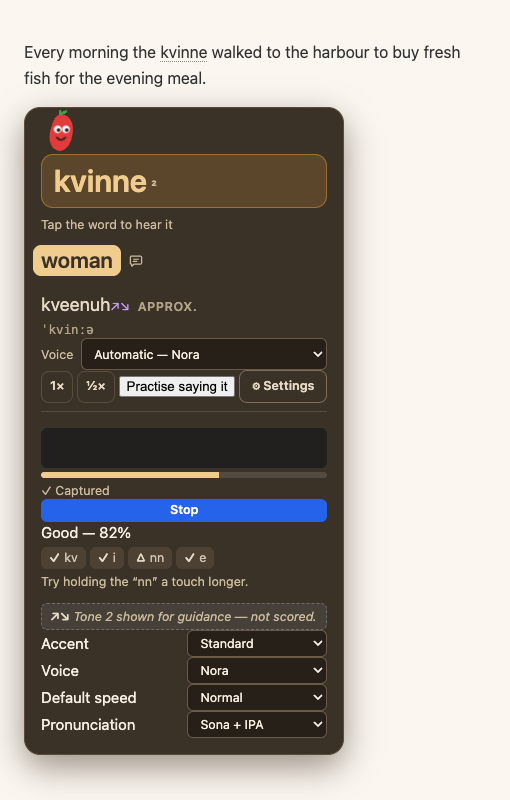
The Word Card for Norwegian kvinne, meaning woman. Sona reads kveenuh with pitch arrows and is marked approx. A small chili companion sits at the top of the card. Voice, speed and accent controls are below.
Norwegian kvinne, in the sentence you were reading. Sona is the line under the meaning. The card can also show IPA.
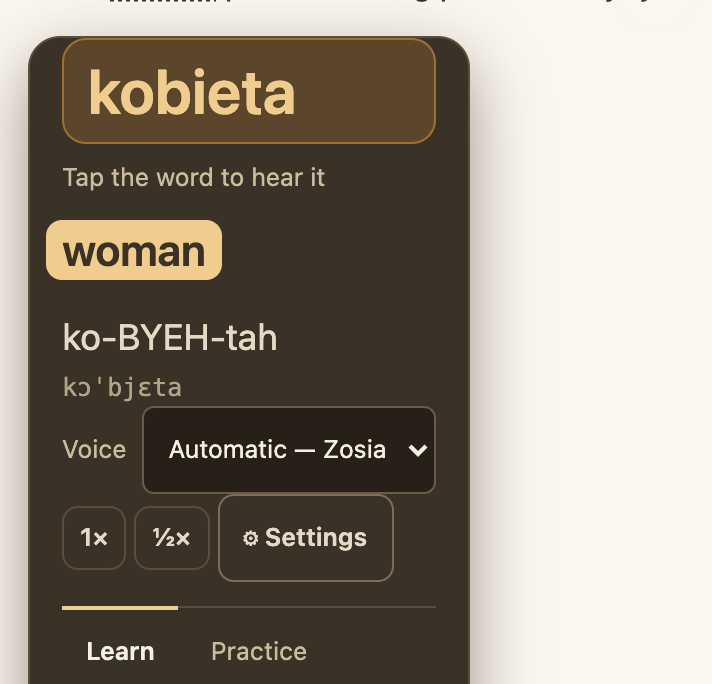
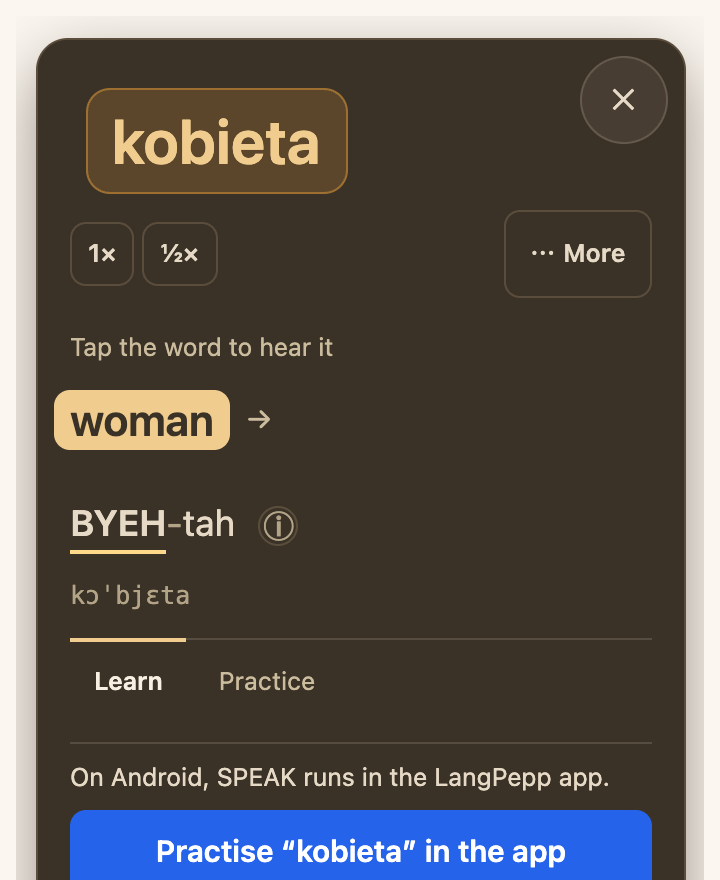
The Word Card for Polish kobieta, meaning woman. Sona reads ko-BYEH-tah. A voice is set to Automatic, Zosia, with buttons for normal speed, half speed and settings.
The same card on a phone, for Polish kobieta. Tap the word to hear it. Half speed is there when you want the beats slower.

What the card keeps close

The word, large enough to tap. The English meaning. Sona, marked approx. A voice already on your device, full speed and half speed, and the accent you prefer.

Spoken audio uses those on-device voices. Most desktops have Polish and Norwegian voices. Some phones have no Norwegian voice, so the card does not promise Norwegian audio on every phone. Sona and the meaning are still there.

The Word Card after speaking Norwegian kvinne. It shows Good, 82 percent, a mark beside kv, i, nn and e, the tip to hold nn a touch longer, and a note that tone 2 is shown for guidance and is not scored.
An example from the card after one attempt. The percentage belongs to that attempt. It is not a score LangPepp keeps a league of.

Say it back

Sound by sound, on your device

Record yourself saying the word. LangPepp marks each sound against it, and gives you a tip you can use on the next try.

For example, after saying kvinne

Good — 82%

Try holding the “nn” a touch longer.

Tone 2 shown for guidance — not scored. For Norwegian, tone is guidance only.

Scoring runs on the device. The recording is never uploaded, never kept after the card closes, and never sent anywhere. The microphone is open only while you record, and you can switch it off completely.

On a phone, speaking is scored in the LangPepp app. A word card in Firefox can open the app on that one word.

Practice Studio

The words you've met, in a phrase you can say

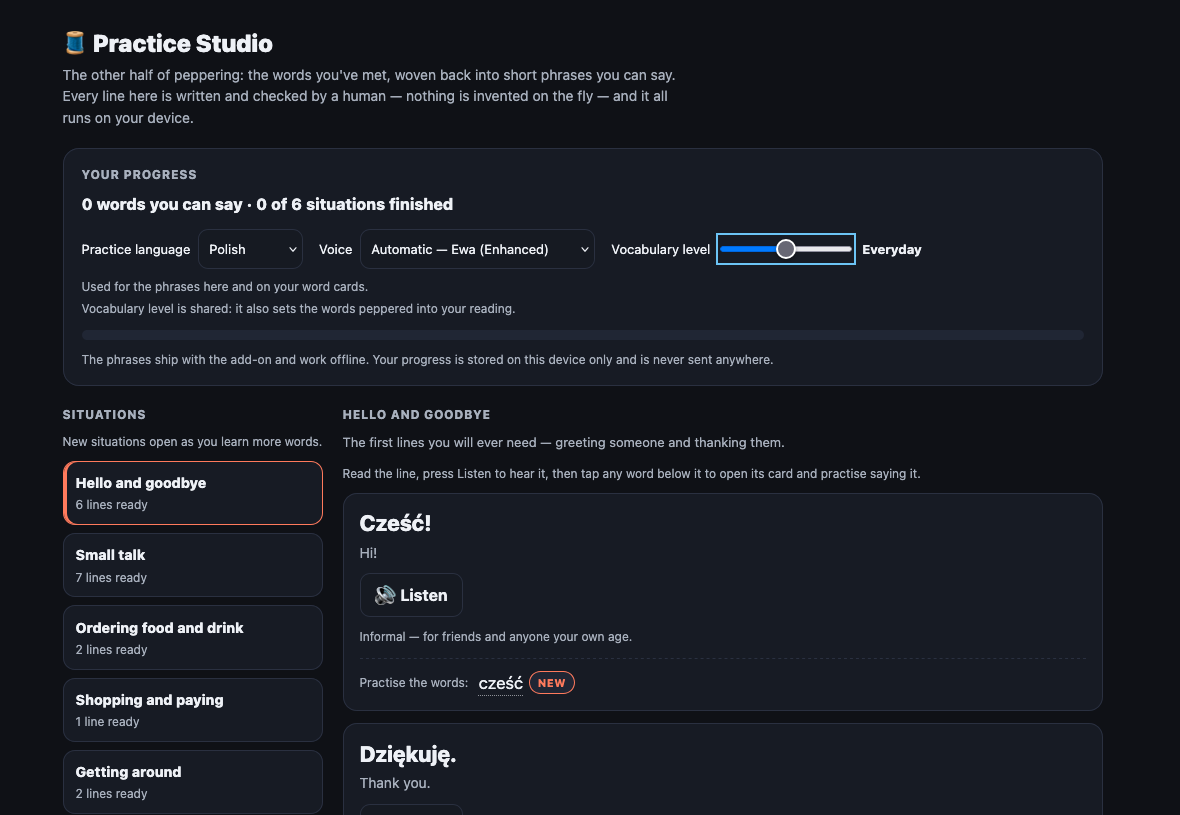
Short everyday situations, woven from words you have already seen while reading. You read the line, press listen, then practise the words.

Every line is written and checked by a human. Nothing is generated on the fly. It works offline.

  • Hello and goodbye
  • Small talk
  • Ordering food and drink
  • Shopping and paying
  • Getting around

A first line might be Cześć, “Hi”, or Dziękuję, “Thank you.” New situations open as you meet more words.

Practice Studio. Hello and goodbye is selected. A phrase card shows Cześć, meaning hi, with a listen button, and the next card begins Dziękuję, thank you.
Practice Studio. The phrases ship with the add-on and work offline. Your progress stays on this device.

Your pace

Turn the shaker up, or down

There is no lesson, and no twenty minutes a day. You turn it up when it feels easy, and down when it doesn't. Nothing asks you to stop reading.

Try it on a short passage

Every I make , drink a glass of , and step out the door into the street. The sun is already up, and a friend waves from the house across the road.

Tap a peppered word to see its meaning.

A light sprinkleA lot
FoundationalFurther along

3 words in this passage, up to everyday.

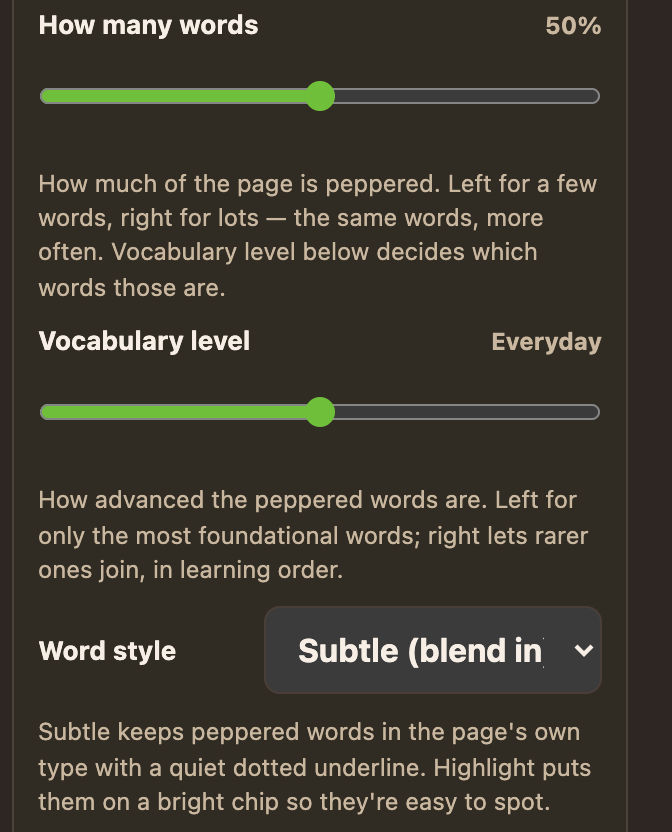
Add-on controls: a slider for how many words are peppered, a vocabulary level slider set to Everyday, and word style set to Subtle, blend in.
The same two sliders, and the word style, in the add-on. Left is a light sprinkle and foundational words. Right lets more, and rarer, words in.

Subtle or Highlight

Subtle blends peppered words into the page's own type, with a quiet dotted underline. Highlight puts them on a soft chip so they're easy to spot.

One site, or a text of your own

You can turn peppering off for a single website. Hold a key, hover any word, and see it in the language you're learning. Or paste song lyrics, or any text, and pepper that.

Rest days, and no nagging

An optional daily goal, such as three words a day. A streak with rest days, so a missed day doesn't wipe it. One optional quiet reminder line. No push notifications, ever.

A collection keeps the words you've met. Yours to keep — nothing here is a race. Short facts travel with the language too, such as Polish's seven grammatical cases.

Private by design

Everything stays on your device.

The word lists, the picking and the pronunciation scoring all run locally. There is no account. No text, history or audio leaves the device.

On the device

Peppering, the Word Card and speaking are scored where you are. Nothing is sent off to be processed.

No account

There is nothing to sign in to. The add-on and the app each keep their own record on their own device.

Offline

It works offline after the first download, including Practice Studio and the word lists.

Microphone

The microphone is open only while you record. You can switch it off completely, and the recording is not kept after the card closes.

Where it runs

Firefox on your desk and your phone, and an Android app

You don't need both. The add-on and the app each work alone, and each keeps its own record on its own device.

Firefox add-on, desktop

Peppers the pages you browse. The full Word Card, listen and speak. Tested on Mac and Linux.

Get the Firefox add-on

Store link coming

Firefox on Android

The same add-on on your phone. A word card can hand a single word to the LangPepp app when you want speaking scored there.

Get the Firefox add-on

Store link coming

LangPepp app for Android

A reader you paste into — an article, a link or a text file. This is where speaking is scored on a phone.

Get the Android app

Store link coming

Only the word travels

A word card in Firefox can open the app on that word, as in “Practise ‘kobieta’ in the app.” Only the word travels: no page, no history, no account.

Listing links are not live yet. The buttons above are where the Firefox Add-ons listing and the Android download will go.

A Firefox word card on Android for Polish kobieta. It says that on Android, speak runs in the LangPepp app, and offers a button to practise kobieta in the app.
Firefox on Android, handing one word to the app.

Coming

Chrome: coming

The extension builds for Chrome. A store listing is not live, so this site does not link to one.

Languages

Polish and Norwegian, to start

Both are fully supported. They suit people who are moving to Poland or Norway, who have a partner or family there, or who are heritage learners.

Polish

kobieta woman · ko-BYEH-tah

Featured, and fully supported, including the Word Card, speaking, and Practice Studio.

Norwegian (Bokmål)

kvinne woman · kveenuh ↗↘

Featured, and fully supported. Pitch is shown on the card as guidance, and it is not scored.

Coming

More languages coming

Request a language from inside LangPepp. The add-on already asks. A public contact for the same request will be published with the contact address.

Request a language

Spoken audio uses the voices already on your device. Most desktops have Polish and Norwegian voices. Some phones have no Norwegian voice, so Norwegian audio is not available on every phone. The meaning and Sona are there either way.

Coming

In the lab

In testing now. Not in the product yet. Nothing in this list is something you can switch on today.

Coming

A much larger Polish list

A larger English to Polish list: every English word with a single Polish equivalent, about 92,000 words, ranked by how common they are.

Coming

The right form, in the sentence

Translation of each sentence on the device, using Mozilla's open-source offline translator, Bergamot, so a peppered word takes the right grammatical form. “I can” becomes mogę.

Coming

Pepper presets

Light, Medium and Heavy: roughly one word in ten, one in five, and one in three of the page. Today, the two sliders do this job.

Coming

Words that move on

Learner-aware words that move further down the list as you learn them, so you are not stuck on the same top words.

Questions

Straight answers